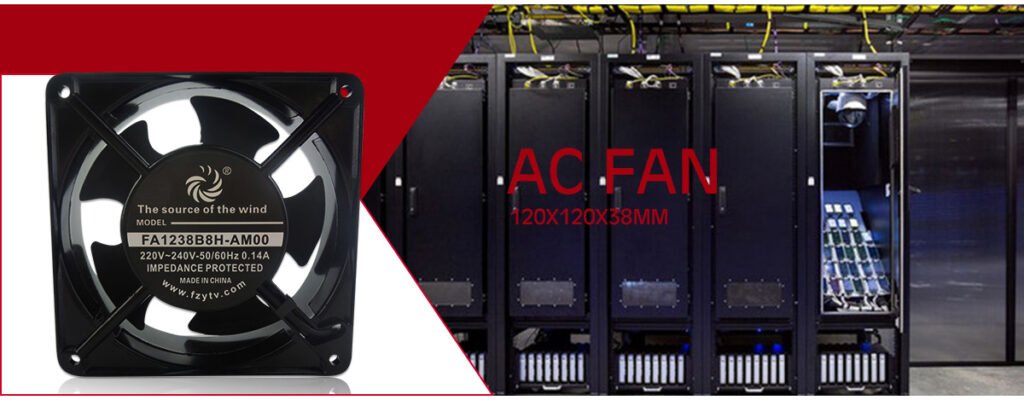
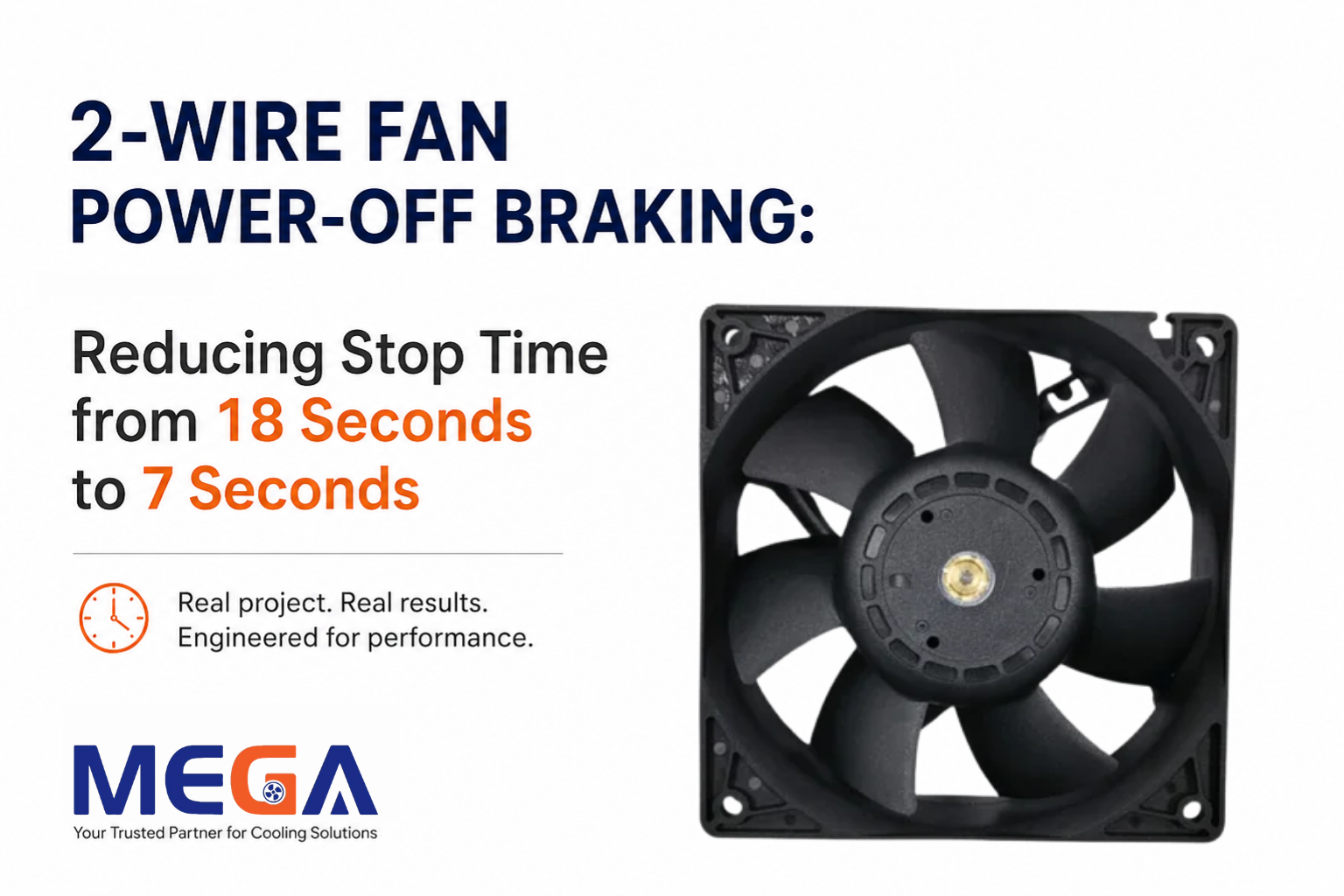
A customer came to us recently with a problem that doesn’t come up often, but when it does, it’s a real headache: their fan kept spinning too long after they cut the power.
Not a huge amount of time in the grand scheme of things. But in their application, 15 to 18 seconds of coast-down after shutdown was enough to be a genuine issue, and it needed to come down, without adding any extra wiring.
Table of Contents
ToggleThe problem: a fan that won’t stop spinning
Cut power to any high-speed impeller and it doesn’t just stop. Inertia keeps it turning, sometimes for a surprisingly long time depending on the fan’s size, speed, and bearing type. For this customer’s cooling fan, that coast-down was landing somewhere between 15 and 18 seconds before the blades came to a full stop.
That’s a long window if you’re dealing with equipment access, moving assemblies nearby, or any process where someone or something needs to interact with the fan shortly after shutdown. A spinning impeller isn’t something you want to reach past.
Why the obvious fix didn’t apply here
The first thing that comes to mind for controlling fan speed is usually PWM. It’s a well-established method, and it works well, but there’s a catch: PWM speed control assumes the fan and its control electronics are still powered. It’s a great tool for slowing a fan down while it’s running.
This customer’s situation was different. They weren’t trying to slow the fan down while it ran. They needed it to stop faster after power had already been cut, and they needed to do it while keeping a simple 2-wire configuration. No extra control line, no added signal wire, nothing beyond what was already there.
That constraint is really what made this an interesting problem rather than a routine one.
Working through it
Our engineering team sat down with the customer’s setup and worked through the fan’s behavior after power-off, looking specifically at how to introduce a braking effect within the existing 2-wire design. There was no spare line available to bring in an active control signal, so whatever solution we landed on had to work with what was already there.
We’ll admit we’re keeping the specifics of the circuit design a bit high-level here, partly because it’s the kind of detail that’s better discussed directly with our engineering team for your specific application. But the short version is that this was a power-off braking approach built into the fan’s own electronics, not a PWM-based fix, and not something that required changing the wiring the customer was already using.
The result
Before: 15 to 18 seconds to come to a full stop after power-off.
After: approximately 7 seconds.
That’s a reduction of more than half the original coast-down time, without adding a wire or changing the fan’s footprint in the customer’s system.
Where this actually matters
Fast stopping after power-off isn’t something every application needs. Plenty of fans are fine coasting down for 15, 20, even 30 seconds with nobody thinking twice about it. But there are situations where it matters quite a bit:
- Equipment where a panel or guard opens shortly after shutdown
- Machinery with frequent access points near the fan
- Systems that cycle on and off often, where coast-down time adds up
- Moving assemblies or serviceable parts positioned close to the impeller
- Any design where a spinning blade right after “off” is a safety concern
If your application falls into any of those categories, it’s worth asking your supplier what their fan actually does in the seconds after power is removed, not just how fast it spins while it’s running.
Why we’re sharing this one
We work on a lot of custom fan and cooling projects that never make it into a case study, mostly because the story is “we built a fan to spec and it worked.” This one stuck with us because it wasn’t really about the fan spinning fast. It was about getting it to stop fast, under a constraint that ruled out the usual playbook.
If you’re running into a similar issue, whether it’s coast-down time, a 2-wire limitation, or something else that doesn’t fit the standard approach, we’re glad to talk through it. Sometimes the fix isn’t a bigger redesign, it’s a smarter one within the constraints you already have.
Get in touch with our engineering team if you want to talk through a similar requirement.
📩 inquiry@cnmegatech.com
🌐 www.cnmegatech.com