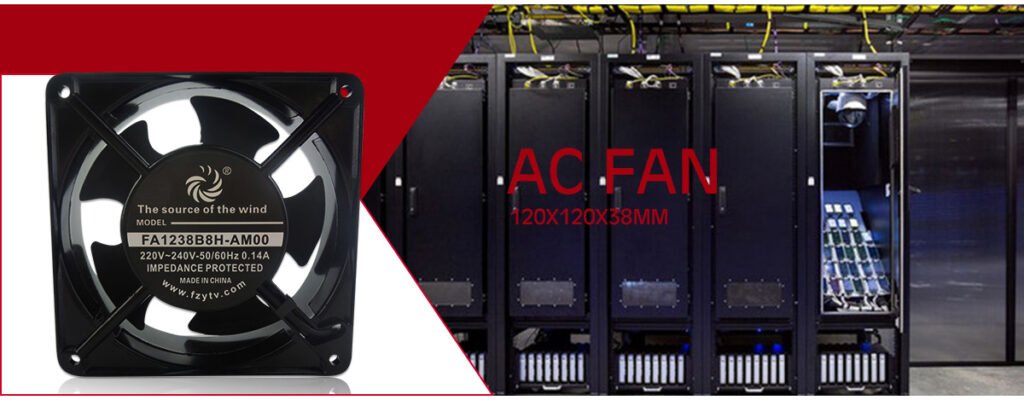

Two fans can share the same footprint, list similarly impressive airflow numbers on the spec sheet, and still behave in completely different ways once they’re mounted inside a real product. One moves air the way the design intended. The other struggles the moment it meets any resistance. The difference rarely comes down to airflow at all.
CFM, or cubic feet per minute, is the number most people check first when comparing cooling fans. It’s easy to compare and easy to market. But CFM by itself describes only one condition: how much air a fan moves when nothing is in its way. Almost nothing in a real product looks like that.
Table of Contents
ToggleWhat CFM Actually Tells You
A fan’s maximum CFM rating is measured in free air. That means no duct, no filter, no heatsink fins, no enclosure walls close enough to create back-pressure. It’s the fan spinning at rated voltage with a completely open path in front of and behind it.
That number is useful for one thing: comparing the raw pumping capacity of different fans under identical conditions. It is not a prediction of how much air the fan will actually deliver once it’s screwed into a chassis, seated against a heatsink, or pulling air through a mesh filter. In almost every real installation, the fan operates somewhere below its maximum CFM, because something in the airflow path is pushing back.
This is the gap that catches a lot of buyers off guard. A fan chosen purely because it had the highest CFM number on the datasheet can end up moving noticeably less air than a lower-CFM fan once both are installed in the same enclosure. The missing variable is static pressure.
The Missing Variable: Static Pressure
Static pressure is a measure of how much resistance a fan can push against while still moving air. It’s typically expressed in mmH2O or InH2O on a MEGA Tech spec sheet, and like CFM, it’s usually given as a maximum, meaning airflow is at zero (the fan is pushing against a fully blocked outlet).
Every real cooling path has some resistance in it. A heatsink’s fin spacing, a dust filter, a perforated panel, a tightly packed PCB layout, or a length of ducting all resist airflow to different degrees. A fan with high maximum CFM but low static pressure capability can lose most of its airflow the moment it meets that resistance. A fan with a lower CFM rating but higher static pressure capability might actually deliver more usable airflow in that same restricted path.
This is why static pressure matters most for centrifugal blowers and any application with a restrictive airflow path, and matters somewhat less for a fan blowing freely across an open board with nothing obstructing it.
Real MEGA Tech Example: Same Footprint, Very Different Performance
MEGA Tech’s 97 x 25mm DC brushless blower (B Type) is available at two different rated speeds. Both share the same housing and footprint, but the performance difference between them is significant.
| Spec | MG9725H12B (9,000 RPM) | MG9725LH12B (14,000 RPM) |
|---|---|---|
| Rated Voltage | 12 VDC | 12 VDC |
| Rated Current | 0.60 A | 1.50 A |
| Rated Input Power | 7.2 W | 18 W |
| Speed | 9,000 RPM | 14,000 RPM |
| Maximum Air Flow | 19.7 CFM | 30.9 CFM |
| Maximum Static Pressure | 58.2 mmH2O | 153.2 mmH2O |
| Noise | 59.9 dB-A | 68.6 dB-A |
Going from 9,000 RPM to 14,000 RPM increases maximum airflow by roughly 57%, from 19.7 CFM to 30.9 CFM. That looks like a straightforward upgrade. But maximum static pressure increases by about 163% over the same jump, power consumption increases by 150%, and noise rises by nearly 9 dB, which is a clearly audible increase.
The 14,000 RPM version isn’t simply “the better fan.” It’s the better fan for an application with meaningful airflow resistance, where that extra static pressure capability is what keeps airflow from collapsing once the fan is installed. If the application has an open, low-resistance path, the 9,000 RPM version may move comparable usable airflow at less than half the power draw and a noticeably lower noise level. The right choice depends entirely on what the fan is pushing air through, not just on which unit has the bigger CFM number.
Why the P-Q Curve Matters
A spec sheet’s maximum CFM and maximum static pressure are two single points. The P-Q curve (pressure versus airflow) is the line that connects every point in between, and it’s the actual performance map of the fan.
MEGA Tech’s catalog includes a P-Q curve for every fan and blower model, plotted with static pressure on the vertical axis and airflow (CFM) on the horizontal axis. Reading that curve tells you something the two headline numbers can’t: how much airflow the fan will realistically deliver at whatever static pressure your specific enclosure, filter, or heatsink actually presents.
For example, the P-Q curve for the 97 x 25mm blower at 9,000 RPM starts at roughly 19.7 CFM with zero resistance and slopes down to roughly 58.2 mmH2O of pressure at zero airflow. A system with, say, 20 mmH2O of resistance in its airflow path would land somewhere in the middle of that curve, not at either endpoint. Estimating performance from the maximum CFM alone, without checking where the system’s actual resistance falls on that curve, is one of the most common fan-selection mistakes.
We’re intentionally not inventing a specific operating point here, because that depends entirely on the resistance of your particular design. The point is simply this: the P-Q curve, not the two maximum numbers at either end of it, is what tells you what a fan will actually do in your product.
More RPM Does Not Automatically Mean Better Cooling
MEGA Tech’s 120 x 120 x 32mm DC brushless blower (A Type) is offered across four rated speeds on the same housing, which makes it a useful case for seeing how RPM, airflow, pressure, power, and noise scale together.
| Speed | Current | Power | Max Airflow | Max Static Pressure | Noise |
|---|---|---|---|---|---|
| 2,500 RPM | 0.5 A | 6.0 W | 26.5 CFM | 20.25 mmH2O | 48.2 dB-A |
| 3,000 RPM | 1.1 A | 13.2 W | 31.9 CFM | 27.47 mmH2O | 51.9 dB-A |
| 3,500 RPM | 1.7 A | 20.1 W | 36.9 CFM | 35.92 mmH2O | 55.6 dB-A |
| 4,000 RPM | 2.2 A | 26.4 W | 41.9 CFM | 48.47 mmH2O | 59.9 dB-A |
Going from 2,500 RPM to 4,000 RPM, a 60% increase in speed, airflow increases by about 58%, which roughly tracks. But static pressure capability more than doubles (up about 139%), power consumption goes up by 340%, and noise climbs almost 12 dB across the range.
That pattern shows up consistently across DC fans: airflow tends to scale close to linearly with speed, but static pressure, power draw, and noise all scale faster. Pushing RPM higher than an application actually needs buys a comparatively small airflow gain at a disproportionate cost in power budget and acoustic output. The conclusion isn’t that higher RPM is a bad choice. It’s that maximum RPM is rarely the optimal one. Fan selection is an optimization problem, weighing how much airflow and pressure headroom the application genuinely needs against the power and noise budget it can afford.
Start With the Application, Not the Fan
Cooling requirements vary enormously depending on what’s being cooled, which is exactly why “highest CFM that fits the mounting holes” is a weak starting point. Looking across MEGA Tech’s own product-to-application guidance, the same physical fan size can end up in very different environments with very different resistance profiles and duty cycles:
- The compact 20mm-class size (2010) shows up in LED displays, industrial control cabinets, servers, telecom equipment, and drone platforms.
- The 60 x 60 x 25mm blower spans solar inverters, battery thermal management, and gaming equipment, while the same size family at a greater depth is also specified into industrial control cabinets, servers, telecom gear, and refrigeration systems.
- The ø90 x 25mm centrifugal fan is used in beauty and photography equipment as well as vacuum and smoke-extraction systems, which have almost nothing in common as airflow environments despite sharing a single fan size.
Two products that use a physically identical fan footprint can have completely different resistance, duty cycle, and noise tolerance. That’s why the engineering process should start with the thermal and mechanical requirements of the system, not with a search filtered by the highest CFM rating in a given size class.
What Information Helps When Selecting a DC Fan
Before comparing spec sheets, it helps to have answers to the following:
- Available fan dimensions and mounting constraints
- Supply voltage and voltage tolerance
- Required airflow, and the expected static pressure or resistance in the actual installed path
- Power budget or thermal limits on the power supply
- Acceptable noise level for the application and its environment
- Operating environment (temperature range, dust, moisture, altitude)
- Whether speed control (such as PWM) or signal feedback (such as tachometer output) is needed
- Bearing type requirements, since ball, sleeve, and hydraulic bearings differ in lifespan, orientation tolerance, and noise characteristics
- Expected duty cycle and service life requirements
Only some of these show up on a comparison chart. All of them affect which fan is actually the right one.
Conclusion
CFM is a real and useful number, but it’s only one input into fan selection, not the whole answer. A properly selected cooling fan needs to match the airflow resistance, thermal load, electrical budget, mechanical footprint, acoustic requirements, and operating conditions of the actual product it’s going into. Two fans with the same CFM rating can perform very differently once static pressure, RPM behavior, and the P-Q curve are taken into account, as the MEGA Tech examples above show.
If you’re developing a product and aren’t sure which airflow, pressure, or noise characteristics actually match your application, MEGA Tech’s engineering team can help evaluate the requirements and identify a suitable standard or customized cooling solution.