A cooling fan can pass every bench test and still have a mechanical weakness. Airflow, noise, and electrical performance tell you how a fan runs. They do not tell you how the assembly holds up when it is pushed.
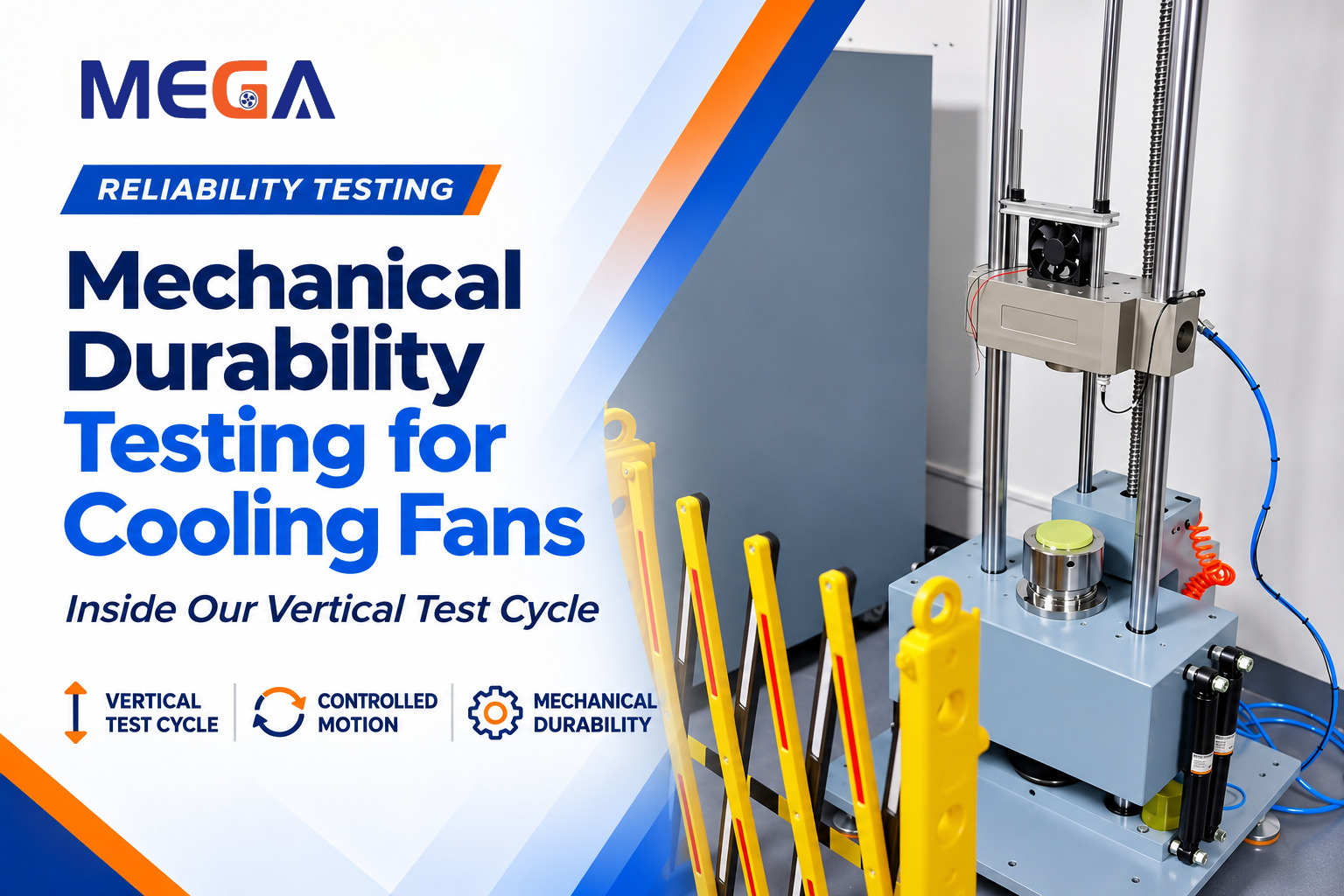
That is why we also test fans mechanically. In the video, a cooling fan is secured in a mechanical test fixture and put through a controlled vertical test cycle to see how the assembled fan responds to physical stress.
This post explains what that test looks for, why normal bench operation can miss these issues, and what to ask any fan supplier about mechanical durability.
Table of Contents
ToggleWhat the test is
In this stage of quality testing, an assembled cooling fan is secured in a mechanical test fixture. The fixture holds the fan in place while it goes through a controlled vertical test cycle.
The purpose is to evaluate how the assembly holds up under physical stress. Because the cycle is controlled, the same conditions can be applied again and again, which makes it easier to compare one fan with another and to spot a fan that behaves differently from the rest.
This sits alongside our other checks, not in place of them. Airflow, noise, and electrical performance are tested separately. This test covers a different question: is the fan physically sound?
What the test looks for
Tests like this help engineers find issues that may not appear during normal bench operation. These include:
- Movement: parts that shift relative to each other when they should stay put
- Loosening: fasteners, joints, or seated components that work free under stress
- Deformation: housings or structures that bend or change shape
- Other mechanical weaknesses: anything in the assembled fan that does not hold up
A fan can look fine, power on, and run cleanly while one of these problems is already present. Putting the assembled fan under physical stress is how you find out.
Why a fan has to be tough as well as quiet
A cooling fan is a small part with a long job. It may spend years inside equipment, and over that time it is exposed to:
- Handling during assembly and servicing
- Transportation from factory to customer to end user
- Vibration from the equipment around it
- Everyday operating conditions that repeat for as long as the product is in use
A bench test does none of this. It powers the fan on a table and measures how it runs. That is the right way to check airflow and electrical behavior, but it is not designed to reveal whether the assembly will stay tight and keep its shape.
For a component with that kind of life, mechanical durability matters just as much as electrical performance. A fan that runs well on day one but loosens or deforms later is still a failed fan from the customer’s point of view.
How mechanical testing fits with the other checks
No single test tells the whole story. Each one answers a different question, and a fan needs to pass all of them.
| Test | The question it answers | What it can miss |
|---|---|---|
| Airflow | Does the fan move the air it should? | Noise quality, electrical faults, physical weakness |
| Acoustic | How loud is the fan, and where does the noise fall in the frequency spectrum? | Whether the assembly is physically sound |
| Electrical | Do the fan’s signals meet the required test parameters? | Whether parts stay tight under stress |
| Aging | How does the fan behave over a long, continuous run? | Weakness caused by physical stress |
| Mechanical | Does the assembled fan hold up under physical stress? | Performance at the operating point, and long-run behavior |
Taken together, these checks cover how a fan performs, how it sounds, how it behaves electrically, how it lasts, and how it holds together. For more on two of them, see our posts on the 1,000-hour aging test and bench testing a seat ventilation fan with a real controller.
What a mechanical test can and cannot tell you
A controlled vertical test cycle is a useful way to find physical weaknesses. It is not a complete picture of how a fan will fare in your product.
It does not replace testing in your own conditions. Every application has its own mix of vibration, handling, mounting, and environment, and the best way to know how a fan will fare there is to evaluate it in that setting.
It also does not predict a service life. It is a way to catch weaknesses in the assembly, not a guarantee about how many years a fan will last.
What it does well is narrow the risk. A fan that moves, loosens, or deforms under a controlled cycle is a fan you would rather learn about in testing than in the field.
Questions to ask any fan supplier about mechanical durability
Whoever you buy from, these questions show whether a supplier tests for physical strength or only for performance:
- Do you test the assembled fan mechanically, or only its performance? Airflow and electrical checks alone do not cover physical weakness.
- What does the test look for? Movement, loosening, and deformation are specific answers. “It’s tested” is not.
- Is the test cycle controlled and repeatable? A repeatable test makes results comparable from one fan to the next.
- Do you test the whole assembly, or individual parts? The assembled fan is what your customer receives.
- How does this fit with your other tests? It should sit alongside airflow, acoustic, electrical, and long-run testing.
- Can testing be adjusted to my application? Handling, shipping, and vibration conditions differ from one product to the next.
A supplier who answers these with specifics is more likely to catch weaknesses before your customer does.
Find weaknesses in testing, not after delivery
Our goal with mechanical testing is simple: find weaknesses during testing, not after the fan reaches the customer.
If you are choosing a cooling fan for equipment that will be handled, shipped, and run for years, tell us about your application. We can talk through your requirements and how testing fits your project.
More on how we test and build: 1,000-hour aging test, seat ventilation fan bench test, and magnetic ring press-fitting.
💬 WhatsApp / Call: +86 135 7056 7086