A fan that runs well on its own is not the same as a fan that works in a car. The only way to know whether a seat ventilation fan and its controller work together is to run them together.
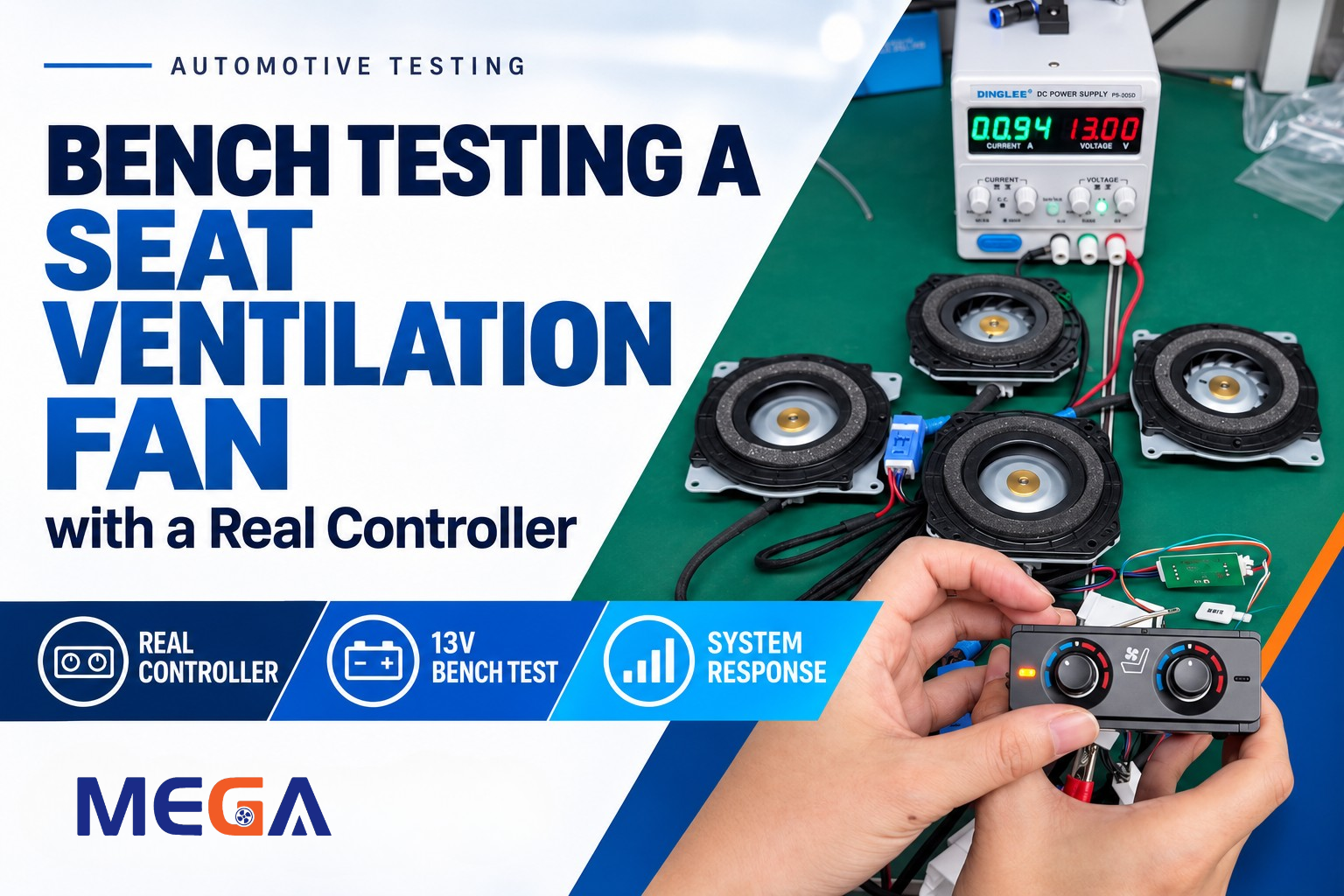
That is the bench test in our video: several compact fans wired to an automotive seat ventilation control system, powered at 13V and driven through the controller’s settings. As the setting changes, the fans respond, and the change in electrical load shows up right on the power supply.
In this post we explain what the test shows, why we run it, and what it means if you are developing a seat ventilation or other automotive cooling product.
Table of Contents
ToggleWhat the Test Setup Looks Like
The setup is deliberately simple. The goal is to see how the real parts behave, not to build a showpiece.
- Fans: several compact fans of the type used in seat ventilation, such as our blowers and DC axial fans
- Controller: an automotive seat ventilation control system, the same kind of module the fans would sit behind in the finished product
- Power: a bench power supply set to 13V
- Method: change the control setting and watch what the fans and the power supply do
Why 13V? Automotive systems are nominally 12V, but a component typically sees a higher voltage with the engine running and a lower one during cranking. 13V is a realistic test point, but a single voltage is a snapshot, not the full range. We come back to that below.
What the Power Supply Readout Tells You
The most useful part of the video is not the fans. It is the readout on the power supply.
When the control setting changes, the fans change speed, and the current they draw changes with them. Because the fans run from a bench supply, that change is visible as it happens, with no extra instrumentation. It gives us three quick checks in one test:
- The command reaches the fan. If the setting changes and the load does not, something between the controller and the fan is not doing its job.
- The response is the one you expected. A higher setting should draw more current and a lower one less. A load that jumps, stalls or does not track the setting is worth investigating.
- The load is in the range the system was designed for. The controller, wiring and connectors are all sized around the current the fans draw, so a fan that draws more than expected is a design question, not just a test result.
None of this needs a vehicle. That is the point of a bench test: you find problems early, while they are still cheap to change.
In the Vehicle, the Fan Never Works Alone
A fan datasheet describes a fan. A seat contains a system. In the finished product, the fan has to work with:
- The controls: the module that sets how hard the fan runs, and how the user adjusts it
- The wiring and connectors: which carry the current and add their own resistance and failure points
- The electronics: the drive circuitry that turns a command into fan behavior
- The voltage range: not one number, but a window the fan must tolerate
- The seat’s air path: which determines what the fan actually has to push against
A fan can meet every line of its own specification and still behave badly in this chain. A control signal it does not respond to as expected, a startup behavior the controller does not like, or a current draw the wiring was not sized for are system problems. They only show up when the parts are connected. It is also why airflow alone does not tell you which fan to choose: the same fan behaves differently against a different air path.
Seat fans also sit close to the occupant, so noise and vibration matter as much as airflow. Small details such as dynamic balancing and impeller clearance in compact blowers decide whether a fan is easy to live with.
That is why we like showing this test. It is the point where the component on the drawing meets what it actually does in the application.
What a Bench Test Can and Cannot Tell You
A functional bench test is a fast, honest first check. It is not vehicle qualification, and we do not present it as one.
| Question | Does the bench test answer it? | What covers the rest |
|---|---|---|
| Do the fans respond to the controller’s commands? | Yes | This test |
| Does the electrical load change the way the setting should drive it? | Yes | This test |
| Do the fan, controller and wiring work together at a normal operating voltage? | Yes, at the voltage tested | This test |
| Does it work across the full voltage range, including the low and high extremes? | Not from one test point | A voltage sweep |
| How much airflow reaches the occupant through the seat? | No | Testing in the real seat air path |
| How does it hold up to temperature, vibration and long-term wear? | No | Environmental and durability testing |
The value of the bench test is that it catches basic integration problems early, before the more expensive testing. It narrows the questions; it does not close them. Anyone developing a seat ventilation product should plan the rest of the validation around their own requirements.
Questions to Ask Any Fan Supplier for a Seat Ventilation Project
Whether you work with us or someone else, these questions separate suppliers who understand the application from those who only sell a fan:
- Have you tested the fan with a real controller, not only on a bench supply? A fan that was only ever tested on its own has not been tested for your system.
- What voltage range is the fan specified and tested for? The answer should be a range, not a single number.
- How does the fan respond to my control method? Ask what it does as the command changes, including at the low end and when it is switched off. Our post on 2-wire fan power-off braking shows why that last case matters.
- What current does it draw, and how does that change with speed? Your wiring, connectors and controller need to be sized for the real figure.
- How do you keep the fans consistent from one batch to the next? A prototype that works is only useful if production units behave the same way. See how we approach it in automated winding and magnetic ring press-fitting.
- Can you support customization? Connectors, lead wires and mounting details often need to match the seat design. Our OEM/ODM team can work from your drawing.
A supplier who can answer these with specifics, and show you a test like the one in our video, is likely to be a good partner for integration.
Talk to Us About Your Project
If you are developing a seat ventilation system or another automotive cooling product, we are happy to talk through your requirements, from the fan itself to how it will work with your controls. Browse our blowers, DC axial fans and EC axial fans, see where our fans are used on the application page, or request a quote.
Have a question about our fans or a custom OEM/ODM project? Email us at inquiry@cnmegatech.com or request a quote.