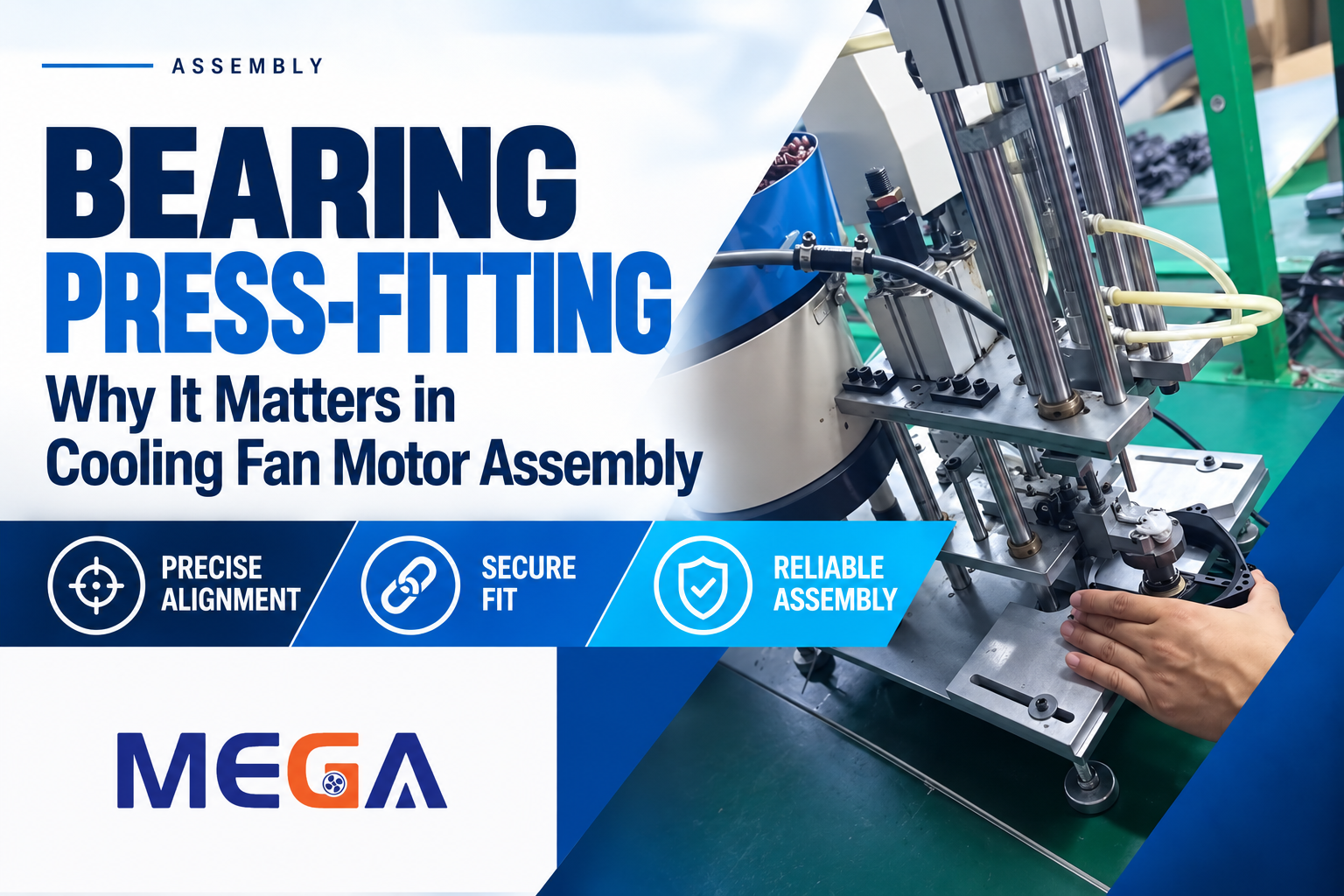
The video behind this post shows a step most people never think about when they picture a cooling fan being built: seating the bearing into the motor housing. Before that, the clip shows a rack of wound motor stators, copper windings in red enamel wire, waiting to be assembled. After the stator is in place, the bearing still has to go in, and how it goes in matters more than the two seconds it takes to watch.
Table of Contents
ToggleWhat Press-Fitting a Bearing Actually Involves
A press fit works on interference: the bearing’s outer diameter is sized very slightly larger than the bore it’s being seated into, so friction, not an adhesive or a mechanical fastener, holds it in place once it’s pressed home. That only works correctly if the force goes in straight, along the bearing’s axis, and stops at the right depth.
Get any of that wrong and the bearing can seat at a slight angle, stop short of full depth, or take uneven load across its race during the press itself. None of those are necessarily visible once the fan is assembled and the housing is closed up. They tend to show up later, as noise, vibration, or a bearing that wears out well before it should.
What the Video Shows
The press in the clip is a vertical, pneumatically actuated station: a twin-guide-rod cylinder assembly with an air line feeding it, mounted above a fixture plate. A motor housing, already carrying its wound stator, gets placed by hand under the press head, and the bearing is seated into the hub in a single controlled stroke.
We’re not going to put a specific force, cycle time, or machine model on this that we can’t confirm. What’s accurate to say from the footage is the setup itself: a single-station pneumatic press used to seat a bearing into the motor housing as a discrete, controlled step rather than something done by hand with a mallet and a prayer.
Why Alignment and Force Control Actually Matter Here
A fan motor only runs as true as its bearing is seated. If the bearing goes in slightly off-axis, the shaft it supports is off-axis too, which shows up as vibration and uneven wear once the motor is spinning at full speed rather than as anything visible on the bench.
Uneven or excessive force during the press can also damage the bearing itself before the fan ever gets powered on, marking or deforming the race in a way that won’t cause an immediate failure but will shorten the bearing’s working life. And the depth the bearing seats to isn’t arbitrary either. It sets the axial position of the shaft relative to the rest of the motor and impeller assembly, which affects clearance and balance.
None of this is specific to one bearing type. Whether the application calls for a sleeve, ball, or hydraulic bearing, which we’ve covered separately in our guide to choosing the right bearing type, the physical act of seating it correctly matters the same way across all three. A good bearing choice undone by a bad press fit is still a bad outcome.
Where This Fits in Building a Fan Motor
Broadly, a fan motor’s assembly moves through winding the stator, mounting it in the housing, then seating the bearing and rotor assembly before the fan is closed up and tested. The red-wired stators at the start of the video are an earlier stage in that same sequence, well before the bearing press-fit shown later in the clip.
We’re describing that as a general progression common to this kind of motor assembly, not asserting it as a fixed, documented step count or sequence specific to every product we build.
Why This Matters to Someone Sourcing a Fan, Not Just Building One
If you’re specifying a cooling fan for your own equipment, the bearing type listed on a datasheet is only part of the story. A correctly chosen bearing that’s poorly seated during assembly can fail at the same rate as the wrong bearing choice entirely, just for a different reason. That’s also tied to the machined precision of the housing itself: a bore that isn’t dimensionally consistent gives the press less to work with even when the process is done correctly.
Reliability in a cooling fan comes from several steps lining up: the right bearing type for the application, a housing machined to hold its bore consistent, and an assembly process that seats the bearing straight and to the right depth every time. None of those steps substitute for the others.
Questions Worth Asking Your Fan Supplier
If bearing reliability matters for your application, particularly anything running continuously or in a harder-to-service location, it’s worth asking a supplier not just which bearing type they use, but how consistently it’s seated during assembly. A fan that’s correct on paper should also be correct on the bench.