Two weeks ago we covered what cooling fan IP ratings actually mean, with footage of one of our fans running fully submerged. That post was about the finished product and the test it has to survive. This one goes back a step, to something that happens earlier in the build: how the electronics inside a waterproof fan get protected before the fan ever reaches a water tank.
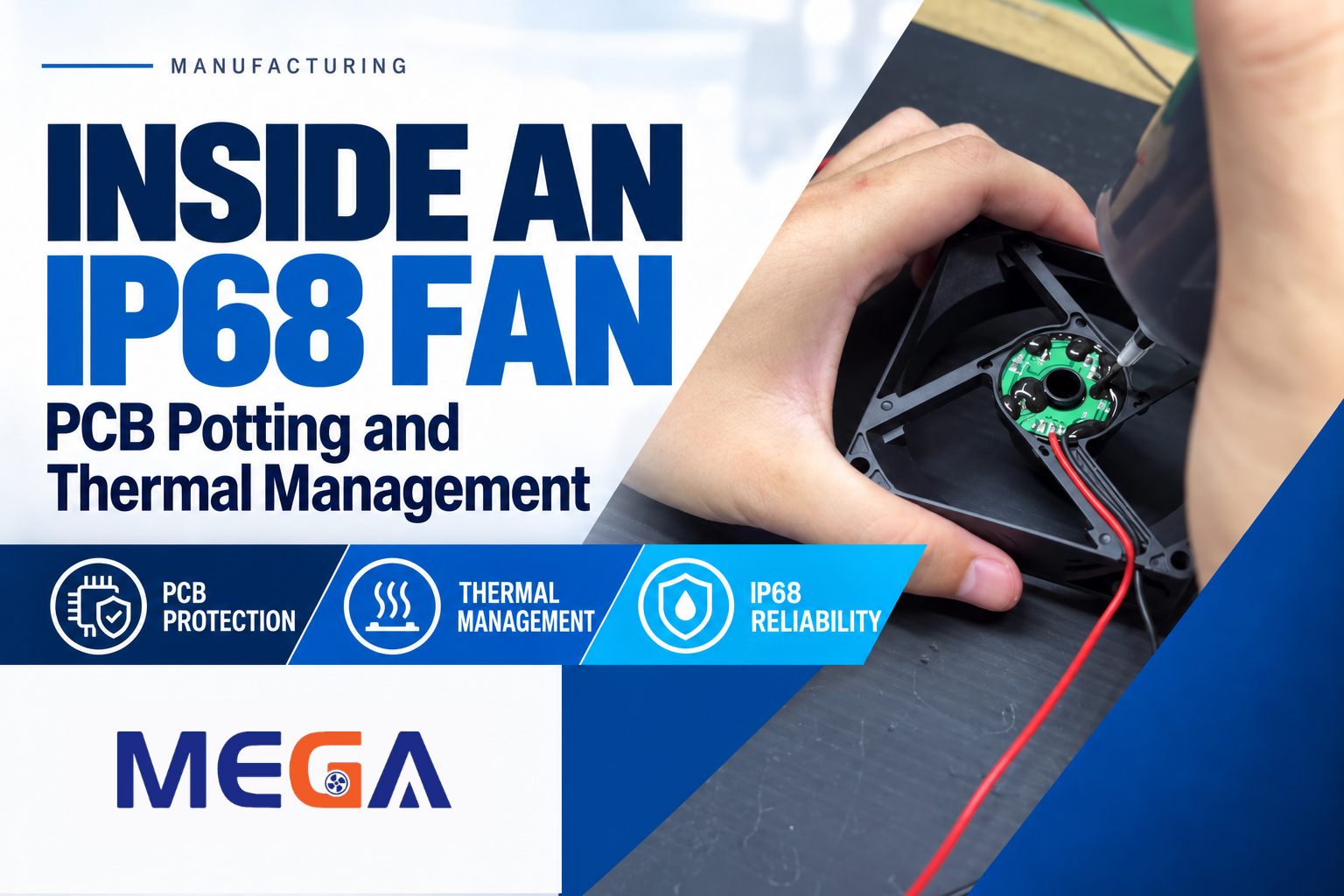
The video behind this post shows potting compound being dispensed into the motor cavity of a cooling fan, filling the space around the PCB and its electrical connections. It’s a short clip. The material it’s placing has more jobs to do than the few seconds of footage suggest.
Table of Contents
ToggleWhat Potting Is Actually Doing
A fan built to run in or around water still needs electronics to operate, and electronics and water don’t mix. Exposed solder joints, connectors, and PCB traces are the first things to fail if moisture reaches them.
Potting solves this by filling the open space in the motor cavity with a compound that cures into a solid barrier around the PCB and its connections, rather than leaving the board sitting in open air inside the housing. Once cured, that barrier is what keeps moisture from reaching the exposed conductors and components that would otherwise be sitting unprotected.
That’s the part that’s easy to picture. The part that’s easy to miss is that sealing the electronics is only one requirement the compound has to meet, not the only one.
Why the Hardest Material Isn’t the Right One
It would be reasonable to assume that a harder, more rigid potting compound gives better protection. That’s not generally true for a PCB application.
Circuit boards, their components, and the materials around them expand and contract with temperature, and a fan motor also experiences ongoing vibration through its working life. A potting compound that cures extremely rigid gives that movement nowhere to go, which means the mechanical stress of thermal cycling and vibration gets transferred directly into solder joints and components instead of being absorbed by the material around them.
The compound used in this process is selected to remain relatively compliant after curing, specifically so the encapsulated electronics have some room to move with thermal expansion rather than being locked into a single rigid mass. The goal isn’t maximum hardness. It’s enough mechanical protection and sealing without working against the electronics it’s supposed to protect.
The Tradeoff Nobody Thinks About: Heat
Here’s the part that’s genuinely easy to overlook. Before potting, heat generated by the motor’s electronics has somewhere to go: it moves into the surrounding air and nearby materials inside the housing. Once those electronics are fully encapsulated, that path changes. They’re now surrounded by a solid material, and if that material doesn’t conduct heat well, the same compound that’s keeping water out is also keeping heat in.
That’s a real problem, because potting the electronics doesn’t stop the motor from generating heat. A compound that seals perfectly but insulates thermally can trade one failure mode for another: instead of water damage, you get electronics running hotter than they were ever designed to.
The compound used in this process has a specified thermal conductivity of 1.6 W/(m·K), which lets it do both jobs at once: sealing the electronics from the environment while still giving heat a path to move away from them rather than building up around the PCB.
Why Thermal Conductivity Has to Be Part of the Spec
Picture two different potting compounds, both fully encapsulating the same PCB, both doing an equally good job keeping water out. If one of them conducts heat noticeably better than the other, the electronics inside each assembly can run at meaningfully different temperatures once the fan is powered on and operating normally.
That’s why a potting compound can’t be chosen only on whether it cures properly, adheres well, and seals out water. For a motor application, what happens after the fan is powered on matters just as much, because the compound becomes a permanent part of the fan’s thermal path, not just its moisture barrier. Treating waterproofing and thermal management as two separate problems misses that they’re solved by the same material at the same time.
Potting Doesn’t Make a Fan IP68 by Itself
This distinction matters enough to state plainly: applying potting compound to a PCB does not, on its own, make a cooling fan IP68.
An IP68 rating describes the ingress protection of the complete, finished fan under defined test conditions, which depends on the entire construction: every point where water could potentially enter, how all the electrical connections are protected, and validation testing performed on the assembled product, not just the motor cavity. Potting is one tool used to protect the electronics inside the fan. Testing is what actually confirms whether the finished design holds up to the rating it’s being built for.
That’s also why our earlier piece on waterproof ratings focused on the finished, assembled fan and the submersion test it had to survive, rather than on any single step inside the build. Potting is part of how an IP68 fan gets built. It isn’t the rating itself.
Not Every Fan Needs This
Potting and higher ingress-protection designs add cost and build complexity, and that’s only worth it when the application actually calls for it. A fan running inside a dry, indoor enclosure doesn’t gain much from a heavily protected, potted motor, and paying for that protection without a real need for it is just added cost.
Potting becomes genuinely relevant when a fan might encounter rain, condensation, washdown cycles, dust mixed with moisture, outdoor exposure, or other conditions where unprotected electronics would be a real reliability risk. That’s the same logic behind choosing the right IP rating instead of defaulting to the highest one available, and it’s consistent with how we’ve approached bearing selection and fan type selection in general: the application should set the spec, not the other way around.
What the Video Doesn’t Show
The clip makes the process look simple: dispense the compound, fill the cavity, let it cure. What it doesn’t show is everything that compound has to keep doing once it’s in place. It has to protect the PCB from moisture. It has to stay mechanically compatible with vibration and thermal cycling instead of working against the components it surrounds. And it has to let heat generated inside the motor keep moving out, rather than trapping it against the electronics.
That combination is what separates potting as a real engineering decision from potting as just filling empty space with resin. For any fan intended to work reliably in a wet environment, what’s happening inside the motor cavity matters as much as anything visible from the outside, which ties directly back to the construction quality we’ve covered in how a fan motor’s bearing gets seated during assembly and in how precisely a metal fan housing gets machined. None of these steps work in isolation. A fan’s reliability comes from all of them holding up together.
Talk to Us About Your Application’s Protection Requirements
If your application involves moisture, washdown, outdoor exposure, or any environment where standard electronics would be a reliability risk, we can help determine what level of protection actually makes sense, rather than defaulting to the highest rating available.
WhatsApp / Call: +86 135 7056 7086
📩 inquiry@cnmegatech.com