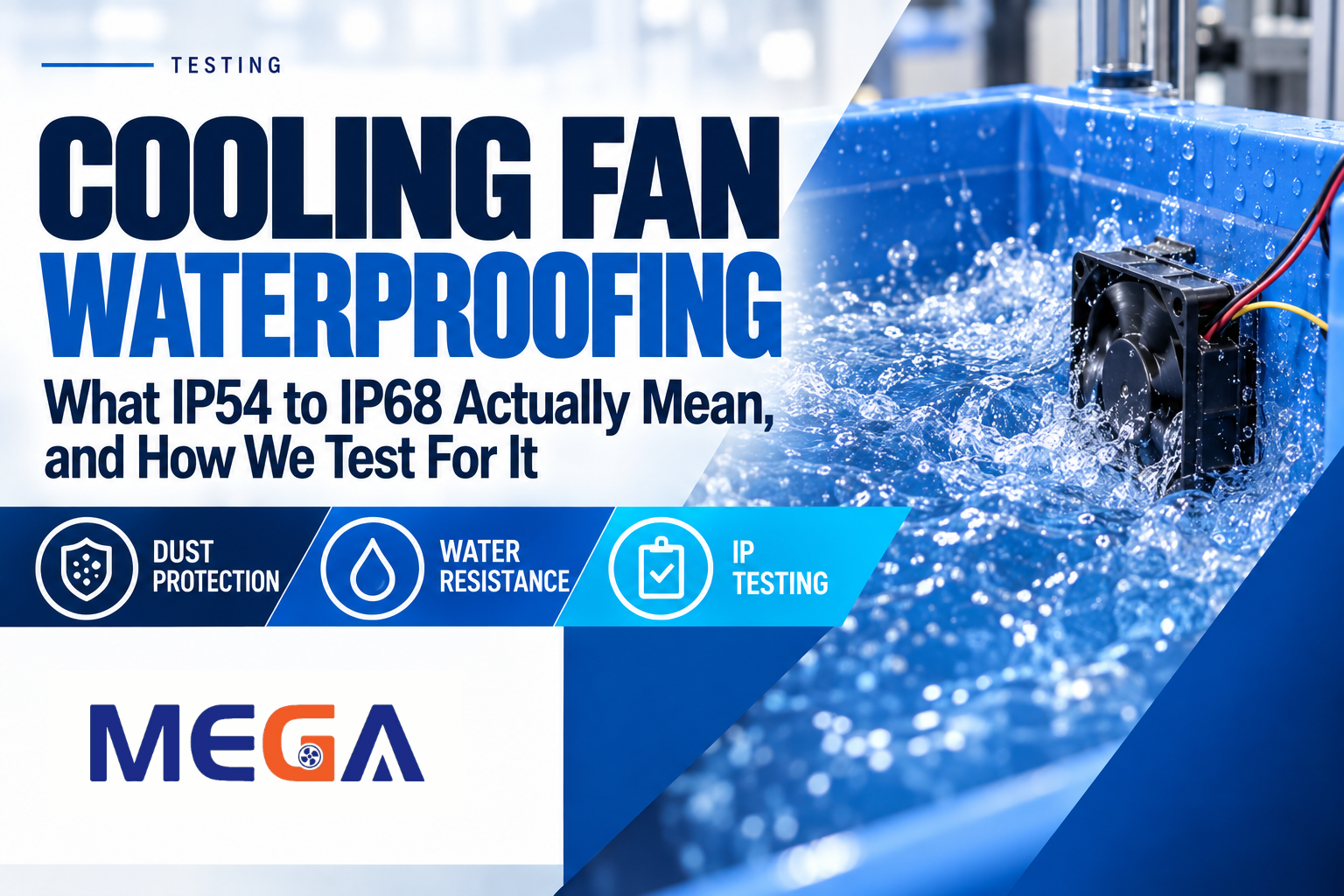
The video attached to this post shows one of our fans lowered into a tank of water, wired and running, fully submerged. It’s not staged for drama. Submersion testing is one of the more direct ways to confirm that a sealed fan actually keeps water out of the motor and bearing while it’s operating, rather than just when it’s sitting still.
Table of Contents
ToggleWhat the Video Actually Shows
A small DC fan is lowered into a water tank by its lead wires, powered, and submerged completely. Once underwater, there’s a visible plume of turbulence around the intake, consistent with the impeller still turning rather than the fan sitting inert at the bottom of the tank. The wires run up out of the water to the power source the whole time.
That’s a meaningfully different test than checking whether a fan survives a splash or a light spray. Running a fan while it’s fully underwater is closer to the kind of validation you’d want before assigning it one of the higher IP ratings, where sustained water contact, not just exposure, is the condition being tested.
What an IP Rating Number Actually Means
IP stands for Ingress Protection, and the rating is two digits, each describing a different kind of protection.
The first digit covers solid particles, mainly dust. A higher first digit means better sealing against dust and debris getting into the housing. The second digit covers liquid ingress, and this is the one that matters for waterproofing specifically:
- 4 typically corresponds to protection against splashing water from any direction.
- 5 typically corresponds to protection against low-pressure water jets from any direction.
- 7 typically corresponds to protection against temporary immersion in water, generally up to about 1 meter of depth for a limited time.
- 8 typically corresponds to protection against continuous immersion beyond that, with the specific depth and duration defined by the manufacturer rather than a single fixed number.
So an IP68 fan and an IP54 fan aren’t the same fan with “more waterproofing” added. They’re built and sealed to withstand genuinely different conditions, and the test methods that confirm each rating are different too, which is why the submersion test in the video is doing something an IP54 splash test wouldn’t cover.
The Ratings We Commonly Build To
We typically produce fans rated to IP54, IP55, IP67, and IP68, with the specific rating selected based on the application. Availability depends on the fan size, housing design, and what the application actually needs, so this isn’t a single fixed spec across every product; it’s a range we can build to on request.
In practice, these ratings tend to map to fairly different environments:
- IP54 fits equipment that’s indoors or sheltered but exposed to dust, light moisture, or occasional splashing, common in general industrial cabinets and enclosures.
- IP55 steps up to environments with direct water jets, such as equipment that gets hosed down or washed as part of regular maintenance.
- IP67 suits equipment that might be briefly submerged, dropped in a puddle, or exposed to heavy rain and flooding for short periods.
- IP68 is for equipment that operates while genuinely underwater, or in continuous heavy wet exposure well beyond what a temporary immersion rating covers.
Why the Right Rating Matters More Than the Highest One
It’s tempting to treat IP68 as the “best” answer by default, but sealing a fan against continuous submersion usually means a more complex housing, additional gasketing, and design tradeoffs that affect cost and sometimes airflow or thermal performance. A fan sealed for continuous underwater operation isn’t automatically the better choice for a piece of equipment that only ever needs to survive an occasional splash indoors.
This is the same logic we’ve covered before when it comes to choosing the right bearing type or picking a fan based on actual static pressure requirements rather than the biggest number on the spec sheet. Waterproofing works the same way: the goal is matching the rating to the actual environment, not defaulting to the highest one available.
What to Tell Us When Requesting a Waterproof Fan
A few details make it much faster to land on the right rating:
- What the fan will be exposed to: dust, splashing, direct jets, occasional immersion, or continuous submersion
- How long that exposure typically lasts, and at what depth if submersion is involved
- Whether the equipment is indoor, outdoor, or subject to regular washdown
- The fan size, mounting, and voltage requirements alongside the environmental exposure
If you’re also working through fan type or performance requirements at the same time, our guide to choosing between axial fans, blowers, and centrifugal fans covers that side of the decision.
Talk to Us About Your Waterproofing Requirements
IP54, IP55, IP67, and IP68 ratings are available on request depending on your application. Tell us what the fan needs to survive, and we’ll help match it to the right build.