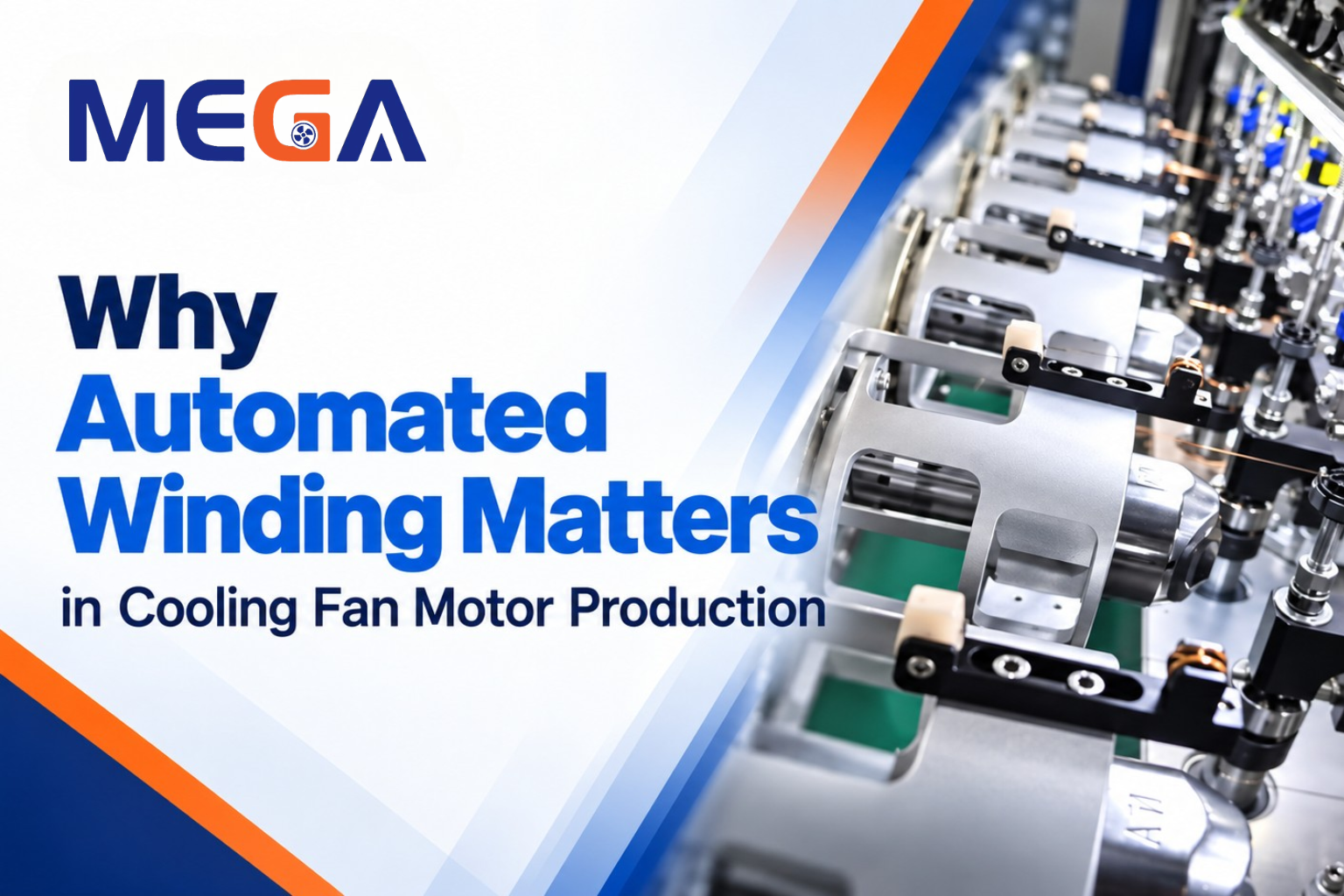
The video behind this post shows a step most people never think about: copper wire being wound onto small motor parts, station after station, with almost no hands involved. It looks simple. It is also one of the steps that most decides how a fan motor behaves once it is running.
In this post we look at what the machine does, why winding is hard to keep consistent by hand, and what automating it means for the fans you buy.
Table of Contents
ToggleWhat Automated Winding Involves
Inside a brushless fan motor, copper wire is wound around the stator in a set number of turns and a set pattern. When current flows through those windings, they create the magnetic field that turns the rotor. That makes the winding the heart of the motor.
A few details decide how well it works: how many turns are wound, where each turn of wire sits, and how tightly the wire is pulled. Together they affect the motor’s resistance, current draw and torque.
Why Winding Is Hard to Keep Consistent by Hand
Fine copper wire is unforgiving. Too little tension and the turns sit loose and uneven. Too much and the wire can stretch or the thin insulation can be damaged. Lose count of the turns, or let the wire cross over itself, and the part no longer matches the one before it.
A skilled operator can wind a good part. Winding hundreds of identical ones in a shift, without drift, is a different job. That is where a machine has the advantage.
What the Video Shows
Several identical stations run side by side. At each one, a motor part sits in a fixture while a rotating arm lays fine copper wire onto it, guided by fixed wire guides. You can see the arms sweep around in the same path again and again, and the wire feed hold steady as they do.
Because every station repeats the same motion, one cycle produces a whole row of matching parts rather than a single one. The operator’s role shifts from placing wire to loading parts, setting up the machine and checking the result.
Why Consistency Matters in a Cooling Fan
Buyers judge a fan by what they can hear and measure: noise, temperature, power draw and service life. Uneven windings can show up as a motor that runs warmer, draws more current or hums where its neighbor does not.
That matters most when you are building the fan into your own equipment. If one batch behaves differently from the last, you see it as a change in your product. When the same program winds every part, differences between parts shrink, and so do the surprises in later assembly and testing.
What Automation Changes on the Factory Floor
- Repeatability. The first part and the thousandth part are made the same way.
- Speed. Multiple stations work in parallel, and the machine keeps the same pace through a long shift.
- Less rework. Controlled wire placement and tension reduce the variation that causes problems later.
- Better use of people. Skilled staff spend their time on setup, inspection and quality control, where judgment matters.
This is the kind of work where automation makes sense: precise, repetitive and needed the same way every time.
Where This Fits in Building a Fan
Winding is one of several controlled steps in our motor and fan assembly. We have covered others, including bearing press-fitting, dynamic balancing and, for sealed models, PCB potting and thermal management. Each step builds on the one before it, so a consistent winding gives the rest of the process a stable starting point.
Why This Matters When You Source Fans
If you buy EC axial fans, DC axial fans or blowers for your equipment, consistency between batches is what keeps your own product stable. Four questions worth asking any fan supplier:
- Is motor winding automated, or done by hand?
- How do you check winding resistance or current on finished motors?
- How do you keep a repeat order the same as the first one?
- Can the winding be customized for my voltage, speed or size requirements?
Automated winding helps us keep this step consistent from one part to the next, so a repeat order can match the one before it.
Have a question about our fans or a custom OEM/ODM project? Email us at inquiry@cnmegatech.com or request a quote.