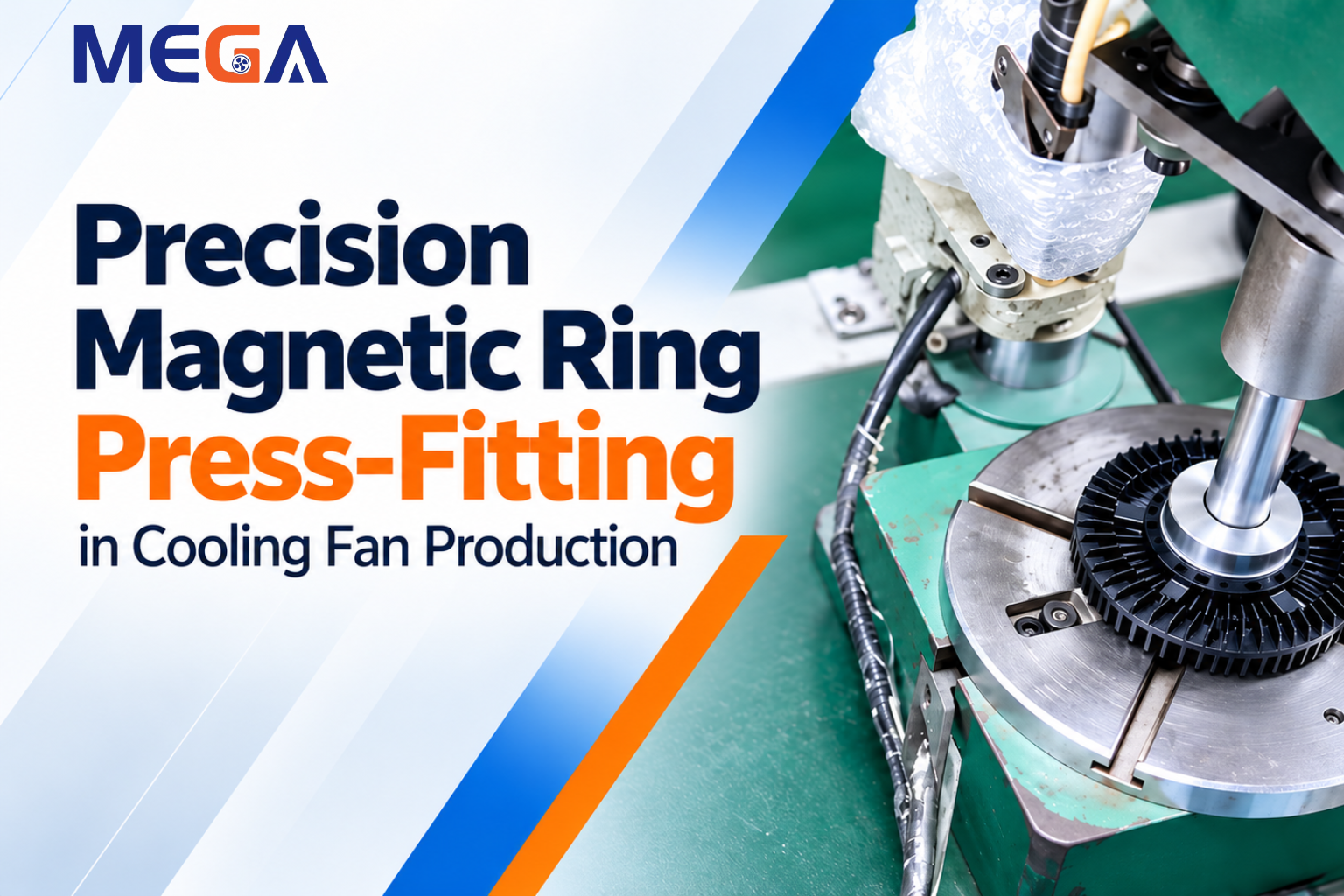
The video behind this post shows a short step that decides a lot: magnetic ring press-fitting. An operator sets a fan impeller on a fixture, a pneumatic press comes down, and the magnetic ring is seated into place. It takes seconds. Done badly, it shows up later as vibration, noise or an early failure.
In this post we look at what magnetic ring press-fitting involves, what the footage shows, and why alignment and force control matter in a cooling fan.
Table of Contents
ToggleWhat Magnetic Ring Press-Fitting Involves
In a brushless fan, the magnetic ring is part of the rotating assembly. Its magnetic field works with the stator windings to turn the fan. Press-fitting means pushing the ring into its seat by force, in one straight movement, so it sits exactly where the design says it should.
Three things have to be right every time:
- Alignment. The ring must go in straight, not tilted or off-center.
- Depth. It must seat fully, at the same height on every part.
- Force. Enough to seat it, but not so much that the ring cracks or the surrounding plastic deforms. Magnet material can be brittle.
What the Video Shows
A fixture holds the impeller in position under a pneumatic press. The operator loads the part, the press comes straight down in one stroke, and the operator removes it and sets it aside. Finished parts are laid out in rows on a sheet of cardboard, ready for the next step.
The division of work is simple. The fixture sets the alignment, the press supplies the force, and the operator handles loading and visual checking. It is not a complex machine, but a good fixture and a steady press give the same result on every part.
Why Alignment and Force Control Matter
A ring that sits crooked or at the wrong depth changes the gap between the magnet and the stator. An uneven gap can mean more noise, more vibration and uneven running. It also adds weight to one side of the rotor, which makes balancing harder.
Force works the same way. Too little and the ring may not seat fully. Too much and it can crack or distort the part. Dynamic balancing can correct small imbalances at the end of the line, but it is far better not to create them in the first place.
What Can Go Wrong Without Control
Press-fitting looks forgiving because the motion is simple, but small errors add up:
- Tilted ring. If the ring starts crooked, it can seat unevenly or bind on the way in.
- Uneven depth. A ring seated slightly high or low changes the magnet’s position relative to the stator.
- Cracked or chipped ring. Too much force, or a hard, misaligned contact, can damage brittle magnet material.
- Loose ring. Too little force, or a worn fixture, can leave the ring not fully seated.
- Debris. A speck of plastic or dust under the ring stops it from sitting flat.
Any of these can pass a quick glance on the line and only appear once the fan is running. That is why this step deserves a proper fixture and a steady press, not a quick push by hand.
How a Fixture and Pneumatic Press Keep the Step Repeatable
Three simple elements do most of the work.
The fixture locates the impeller in the same position every time, so the ring always meets its seat from the same angle. The pneumatic press moves in a straight vertical line and delivers the same stroke on each cycle, which is steadier than any hand-applied force. The operator loads, unloads and inspects each part, catching an obvious problem before the part moves on.
Not every step needs a fully automatic machine. Where a simple fixture and press hold alignment and force steady, that is often the right tool. It is also easy to set up, adjust and repeat from one shift to the next.
What a Good Result Looks Like
On a finished part, the ring sits fully seated and level, with no visible cracks or chips and no gap on one side. The impeller turns freely, with no scraping or rubbing.
Parts from the same batch should also look alike, which is the real test of a repeatable process. A difference you can spot by eye usually means something upstream, such as the fixture, the part or the press, needs attention.
Where This Fits in Building a Fan
Press-fitting the magnetic ring is one of several controlled steps in our motor and fan assembly. We have covered others, including automated winding and bearing press-fitting. Each step builds on the one before it, so a ring that is seated correctly gives balancing and final testing a stable starting point.
Why This Matters When You Source Fans
If you buy EC axial fans, DC axial fans or blowers for your equipment, small assembly details like this decide whether one batch matches the next. Four questions worth asking any fan supplier:
- How is the magnetic ring seated: by press-fit, adhesive, or both?
- How do you control press depth and force?
- Do you check balance and noise after assembly?
- How do you keep a repeat order the same as the first one?
Have a question about our fans or a custom OEM/ODM project? Email us at inquiry@cnmegatech.com or request a quote.