A fan that spins on day one hasn’t proved anything yet. Turning on is the easy part. Running consistently for weeks is the real test.
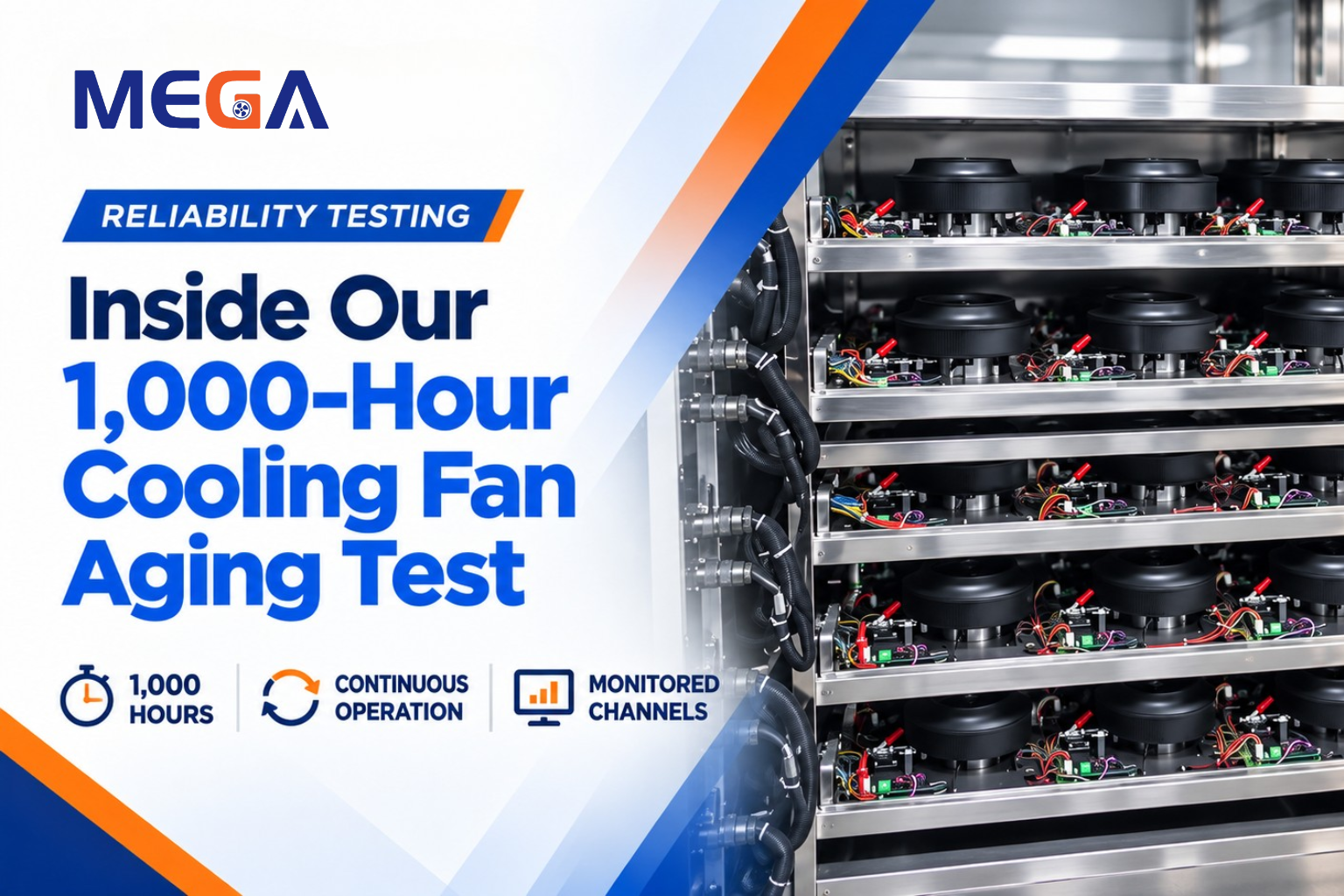
That is why our standard aging test runs for 1,000 hours, which is nearly six weeks of continuous operation. In the video, you can see racks of fans running side by side while their test channels are monitored throughout the run.
This post explains what an aging test is, why we run it for that long, and what it can tell you that a quick functional check cannot.
Table of Contents
ToggleWhat an aging test is
An aging test runs a product continuously for an extended period and watches how it behaves. For cooling fans, the point is to learn how a fan performs with hours on the clock, not just at the moment it is first powered up.
In our test, multiple fans are mounted in racks and operated at the same time, side by side. Each fan is connected to a test channel, and those channels are monitored throughout the run rather than checked once at the start and once at the end.
That setup lets us run many fans at once and keep an eye on all of them for the full duration. It is a different question from a production-line check: not “does it turn on?” but “how does it behave over time?”
Why 1,000 hours
Our standard aging test runs for 1,000 hours. That is about 41.7 days, or nearly six weeks, of continuous operation with no off switch.
The length matters because time is what a quick check cannot give you. A short inspection confirms that a fan starts and runs. A long run gives a fan time to show how it behaves once it has been working for a while, and gives us time to notice if something changes.
It also means the result is not a single reading. Because the test channels are monitored throughout, the record covers the whole run instead of one moment in it.
1,000 hours is our standard duration, not a fixed rule. We can run a shorter or longer test when a project calls for it, which we cover below.
What a long run can show that a short check cannot
Some issues do not appear in the first minute. They appear with hours on the clock. An extended run is a chance to see them in our test racks instead of in your product.
Depending on what is monitored, a long run can help answer questions like these:
- Does the fan keep running? A fan that stops partway through the run is a very different result from one that runs the whole way.
- Does its behavior stay steady? Gradual changes over time are easy to miss in a snapshot and obvious in a record.
- Does anything happen intermittently? An occasional fault is unlikely to show up in a short check. It has far more chances to show up over weeks.
- Do fans from the same group behave alike? Running many fans side by side makes differences between units easier to see.
An aging test is not the whole picture. It does not replace testing for temperature extremes, vibration, or the conditions of your specific application. What it adds is a long, continuous look at how the fan behaves while running, which a short inspection cannot give.
Production-line check vs aging test
Both tests matter. They answer different questions, so one cannot stand in for the other.
| Production-line check | Aging test | |
|---|---|---|
| Question it answers | Does this fan work right now? | How does this fan behave over time? |
| Duration | Short | Extended, 1,000 hours as standard |
| Fans tested | Typically every fan, as it is built | A group of fans run together |
| Best at catching | Fans that are faulty out of the box | Problems that only appear with running time |
| Can miss | Anything that needs hours to show up | Application-specific conditions it does not simulate |
A production check keeps defective units from shipping. An aging test tells you how the design and build hold up when a fan keeps running. For applications where long-term reliability counts, you want both.
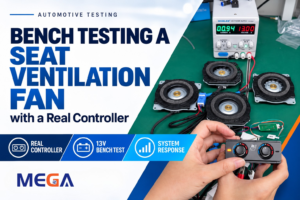
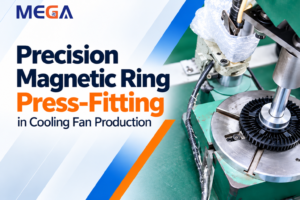
We also test fans as part of a complete system, not only on their own. For an example, see our bench test of seat ventilation fans with a real controller. For how we build consistency into assembly, see our post on magnetic ring press-fitting in cooling fan production.
Test length and requirements can be adjusted
1,000 hours is where we start, not where we stop. Testing requirements can be adjusted around the needs of a specific project or customer qualification process.
If you have a qualification plan, the useful things to tell us up front are:
- How long the test should run, if your process specifies a duration
- What should be monitored, so the test channels capture what you will be evaluated on
- How the fan will run in your product, since the test setup can be matched to the real application where practical
- What records you need, so the results arrive in a form your team can use
The earlier these are settled, the easier it is to build the test around your product instead of retrofitting it later.
Questions to ask any fan supplier about long-term testing
Whoever you buy from, these questions show whether a supplier tests for the long run or only for the first power-up:
- Do you run extended tests, and for how long? A specific number of hours is a better answer than “yes.”
- What is monitored during the run? A test that is watched throughout tells you more than one checked only at the start and end.
- How many fans run at once? Testing a group makes it easier to see how consistent the units are.
- Can the test be adjusted to my qualification process? Your duration and requirements may not match a supplier’s default.
- What do I receive afterward? Ask what records or results come with the test.
- How does the aging test fit with your other checks? It should sit alongside production inspection and final testing, not replace them.
A supplier who can answer these with specifics is far more likely to have built reliability into the process.
Need a fan validated for the long haul?
If long-term reliability matters in your application, tell us about your project and your qualification requirements. We can talk through test duration, what to monitor, and how the aging test fits into your process.
More on how we test and build: seat ventilation fan bench test and magnetic ring press-fitting.
📩 inquiry@cnmegatech.com
🌐 www.cnmegatech.com
💬 WhatsApp / Call: +86 135 7056 7086