Table of Contents
ToggleThe Secret Physics of Cooling Fan Blades
Have you ever wondered why some fans have three blades while others have eleven?
Most people think it’s just for looks. But they’re wrong. In reality, the number of blades is one of the most critical decisions in thermal management. Consequently, if you get this wrong, your device either overheats or sounds like a jet engine.
At MEGA Tech, we’ve spent years perfecting these configurations for everything from EV chargers to medical devices.
Here is exactly how the math works.
1. The Science of Numbers: Airflow vs. Pressure
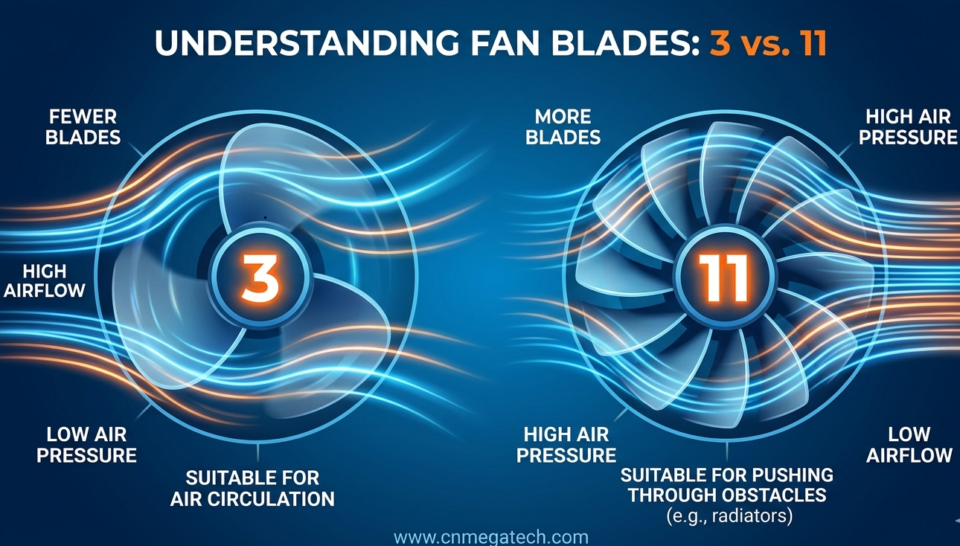
3 to 5 Blades: The Airflow Specialists
When you need to move a massive amount of air through an open space, fewer blades are usually better.
- The Trade-off: These fans provide high airflow but very low static pressure.
- The Application: Think of large-scale ventilation or simple exchange systems where there are no filters or tight gaps.
- The Downside: Because the blades are larger and move more air per rotation, the noise levels tend to be higher.
5 to 7 Blades: The “Golden Equilibrium”
In the world of engineering, this is the “sweet spot.”
- Why it works: These fans offer a perfect balance between stability, noise, and performance.
- The Application: Most standard electronics use 5 or 7 blades because they handle moderate resistance without sacrificing efficiency.
7 to 11 Blades: The Pressure Powerhouses
As the blade count increases, so does the static pressure.
- The Goal: These fans are designed to “push” air through high-resistance environments.
- The Application: If you are designing for sealed environments or high-density heat sinks (like EV chargers or compact servers), you need these.
- The Benefit: They offer high reliability and consistent cooling even when space is extremely tight.
2. Why Use Odd Numbers? (The Industry Secret)
You’ll notice that almost no professional cooling fan uses 4, 6, or 8 blades. Why? Here are the three big reasons why odd is better than even:
A. Avoiding Resonance and Vibration
Even-numbered blades are symmetrical. If you have 4 blades, two blades are always moving in the same axis simultaneously. This creates a “symmetrical vibration” that can lead to resonance. Over time, this vibration can destroy your bearings and shorten the fan’s lifespan.
B. Superior Acoustic Control
Odd-numbered blades break up the frequency of the sound. Instead of a harsh, repetitive “drone” caused by symmetrical air pulses, odd blades create a more “white noise” effect. This results in a much quieter user experience.
C. Mechanical Stability
During the manufacturing and molding process, it is actually easier to balance an odd-numbered fan for high-speed rotation. This ensures that when your fan runs at ultra high speed, it stays stable and reliable for years.
3. Customizing Your Thermal Strategy with MEGA
Ultimately, there is no “perfect” number of blades—only the perfect number for your specific project.
That is where we come in. At MEGA, we don’t just sell “off-the-shelf” fans. We work with you to:
- Optimize size and airflow based on your internal layout.
- Design custom brackets and frameless fans (20mm to 50mm) for tight spaces.
- Ensure durability with IP68 waterproof ratings for outdoor applications like EV chargers.
Whether you are a startup looking to secure funding or an established brand needing a cost-effective alternative to EBM Papst or Sanyo Denki, we have the engineering expertise to help.
Don’t guess when it comes to cooling. Whether you need a 3-blade airflow giant or an 11-blade pressure beast, the right choice makes all the difference.
Ready to optimize your design? Contact MEGA Tech today for a custom consultation.
Articles you may also like:
Essential Role of Cooling Fans in the Medical Industry
Elevating Cooling Efficiency: Mega Refrigerator Fans
Essential Role of Cooling Fans in the Medical Industry
MEGA Boosts Performance and Cuts Costs with Custom DC Fan Replacements
2006 Micro Blower: Ultra-Thin Cooling That Actually Moves Air
15mm Ultra-Mini Fan: High-RPM Cooling for Micro-Electronics