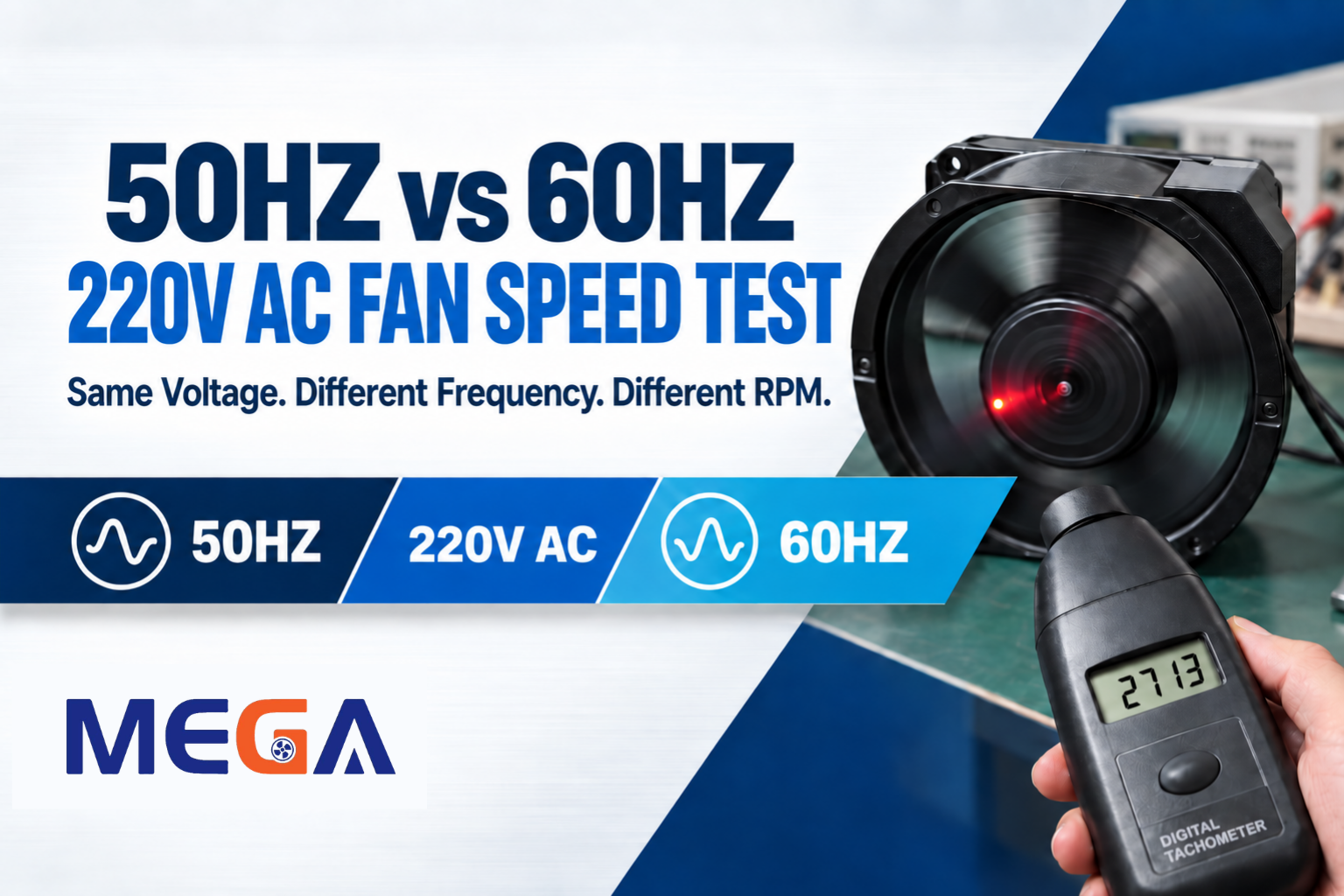
Same fan. Same 220V supply. Same everything, except the frequency of the power feeding it. And the fan still ends up spinning at two different speeds.
We ran this as a simple bench test: one AC brushless fan, powered from an adjustable AC source, tachometer aimed at the blade. First at 50.0 Hz, then again at 60.0 Hz, with nothing else changed.
Table of Contents
ToggleWhat We Measured
At 50.0 Hz, the tachometer settled at approximately 2,713 RPM. Switching the source to 60.0 Hz, with the same 220V supply, the same fan, the same measurement setup, brought the reading up to approximately 3,050 to 3,060 RPM.
That’s roughly a 12 to 13 percent increase in speed from a 20 percent increase in frequency (50 Hz to 60 Hz is a 20 percent jump). The speed didn’t scale one-to-one with frequency, and that gap is worth understanding, because it’s not measurement error. It’s how AC induction motors actually behave.
Why Frequency, Not Just Voltage, Changes Fan Speed
For an AC-powered fan built around an induction or shaded-pole motor, speed is tied to the frequency of the supply, not just its voltage. The motor’s underlying synchronous speed is set by the frequency and the number of motor poles. Feed it 60 Hz instead of 50 Hz, and the synchronous speed rises proportionally, by that same 20 percent, regardless of whether the voltage stayed at 220V the whole time.
What actually reaches the blade is a bit lower than that theoretical synchronous speed, because real induction motors run with some slip between the rotating magnetic field and the rotor itself. That’s exactly what shows up in the numbers above: a 20 percent jump in frequency produced roughly a 12 to 13 percent jump in measured RPM, not a full 20 percent. The shortfall is the motor’s slip, not a flaw in the test.
This is specific to AC induction-type motors. It’s worth noting for anyone used to thinking about DC brushless fans, where speed is set electronically rather than being tied to a supply frequency: an AC fan’s speed genuinely moves with the frequency of the wall power in a way a DC fan’s doesn’t.
This Behavior Shows Up in the Catalog, Not Just the Test Bench
The video wasn’t an isolated result. Mega Tech’s own published specification for its AC Brushless Fan line lists paired RPM ratings for exactly this reason, one rated speed for 60 Hz operation and a lower one for 50 Hz, on the same 220V fan. The published ratio between those two rated speeds works out to roughly 1.14, and the ratio we measured on the bench, about 1.13, lines up closely with it. Both sit below the theoretical no-slip ratio of 1.2, which is exactly the pattern a real induction motor should show.
In other words, this isn’t a quirk specific to one test unit. It’s a documented, repeatable characteristic of how these fans are rated and how they actually perform.
Why This Matters Before a Product Ships
50 Hz is the standard mains frequency across most of the world, including Europe, most of Asia, and most of Africa. 60 Hz is standard in North America and parts of South America and Asia. A product that’s only ever been tested on one of those two doesn’t have a confirmed answer for the other.
If a product with an AC cooling fan is heading to more than one of these markets, checking actual measured RPM (and the airflow, noise, and power draw that come with it) at both 50 Hz and 60 Hz is a validation step that belongs in the test plan before the product ships, not something to discover afterward from a field complaint about a fan running faster, louder, or hotter than expected in one region.
Sourcing an AC or DC cooling fan for a product headed to multiple markets? Mega Tech can help confirm real performance across the frequencies and voltages your product actually needs to support.
Get in touch with our team